I'm a graduate student who loves to travel during my free time. The goal of this website is to help others do the same. When all of us get to travel, explore the world, and experience different cultures, it makes it more enjoyable to share our stories.
On a recent trip to Morocco, my family and I were scheduled to fly via Ryanair from Fes, Morocco, to Marrakesh, Morocco. For those of you not familiar with Ryanair, they are the Spirit Airlines of Europe and the pioneer of the low-cost carrier model. When you book Ryanair, you should be informed that you’re getting a bare-bones flying experience at a very low cost to get you from point A to point B. They operate a very successful business due to their cheap airfare and vast network that has them operating several routes with little to no non-stop competition. I knew of the horror stories regarding Ryanair since the internet has Reddit pages and YouTube videos of travelers giving details about their experiences. Ryanair is the only airline that serves non-stop flights between Fes and Marrakesh, and it has prioritized expanding its service within Morocco. Had there been a competitor (I’m shocked Royal Air Maroc, the national airline of Morocco, does not serve this route), I would have paid more or redeemed more miles to avoid flying Ryanair. These two cities don’t link via high-speed rail yet, so that was not an option. Unfortunately, this left us with two options: take the seven-hour car ride with three kids or book with Ryanair and incur the risks of using their service. The tickets for the one-way flight were only 17 Euros, so even after paying for two checked bags and priority boarding, it was still a great deal. I thought it was a risk worth taking.
During the summer of 2023, my family and I took a trip to Zambia and South Africa to reconnect with relatives, have new experiences, and see the sights for which Africa is renowned. We wanted to experience a safari and stay in a lodge that would bring us close to the wildlife, both during game drives and on the lodge premises. We also needed a lodge that was amenable to having a 10-month-old, a three-year-old, and a four-year-old on the game drives. We researched several of Africa’s larger and more renowned game parks, such as Serengeti, Masai Mara, and Kruger. Almost all had an age requirement that would have excluded us from experiencing game drives in an open jeep as a family. My cousins informed me about Mopani, a safari lodge that didn’t have age restrictions and had game drives that toddlers and infants could also enjoy in an open jeep. Upon the strong recommendation of my cousins, who have visited multiple times, we booked our stay at the Mopani Lodge, located outside South Luangwa National Park in Zambia. This was the experience of a lifetime, and our stay was exceptional in every aspect, from the accommodations and service to the knowledgeable tour guides to the delicious food served daily. Here is a detailed recap of both our drive to the location and our stay.
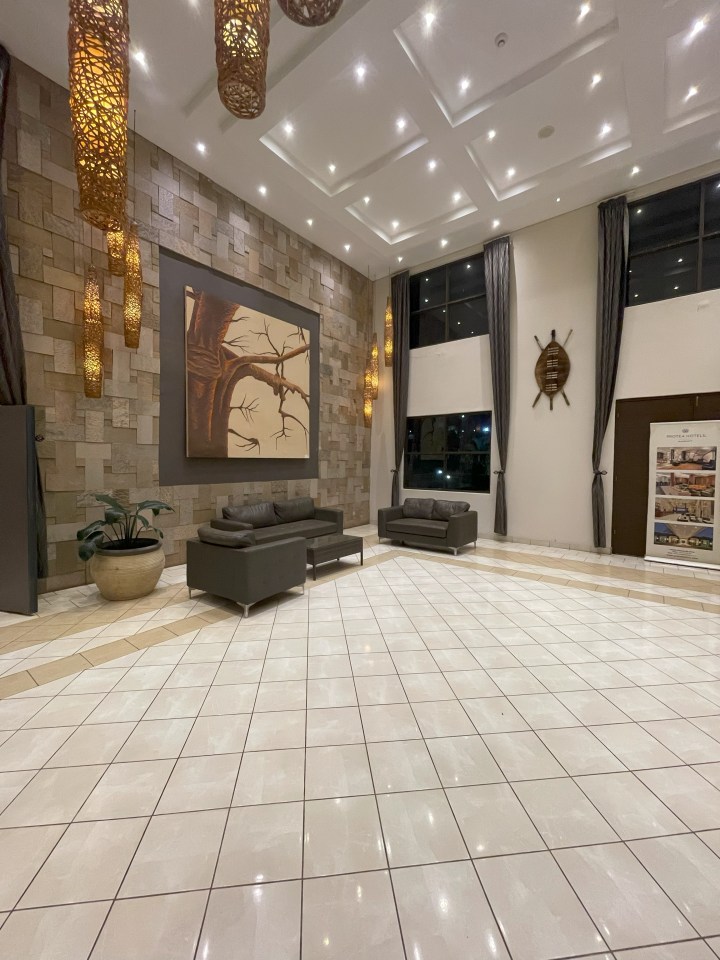
On our way to South Luangwa National Park from Lusaka, we stayed a night at the Protea Hotel in Chipata. Protea is part of the Marriott hotel portfolio and is ubiquitous in Africa. I had never heard of this brand until I was searching on Marriott’s app for hotels in Chipata. About two and a half hours from South Luangwa National Park, Protea Hotel proved an excellent accommodation to break our journey.
Due to my employer’s generous paternity leave policy, my wife and I anticipated having a two-month break in the summer of 2023. With this in mind, we began planning a trip to Asia in November 2022. Our boys were four years, three years, and 11 months at the time of our travel. While this was undeniably an ambitious undertaking, we had taken steps in previous years to prepare for such adventures. Trips to Hawaii and Alaska with our older two boys helped us test various strategies to prepare them for long flights. With each excursion, we witnessed their growth, maturity, and enthusiasm for travel, giving us a cautiously optimistic outlook for a lengthy flight to Japan. Past experiences also taught us the unpredictability of traveling with toddlers and infants. Despite meticulous itinerary planning, we recognized that unforeseen needs could arise. Accepting this reality lessened potential disappointments if we couldn’t check off every item on our agenda. For weeks, my wife and I debated whether to opt for closer destinations like Europe or Central America or fully commit to Asia. The recurring question in our discussions was, ‘If not now, when?’ Planning an itinerary covering multiple countries on the other side of the globe required more than the typical 14 consecutive days off I usually receive. With a blessed two months off, the opportunity was now or potentially far into the future. While cautiously optimistic, we acknowledged the trip’s potential to become a disaster. Uncomfortable kids in unfamiliar settings, failed attempts to address their discomfort, difficulties overcoming jet lag, and the worst-case scenario of a child falling ill were all factors we considered. We hoped our kids would acclimate to different social norms in a foreign country and gain an appreciation for a world beyond America. It became clear that, for an extended trip, including kid-friendly activities in the itinerary was crucial. Although my wife and I love historical sites and museums, understanding that presenting an ancient temple after a 13-to-14-hour flight might be challenging for the kids, we prioritized activities that excited them. Planning around places and experiences that captured their enthusiasm ensured a more enjoyable trip, as their behavior ultimately determined the quality of our adventure.
Once our memorable stay in Japan concluded, we set off for Bali, Indonesia, embarking on an extended travel day that involved a seven-hour flight from Osaka to Singapore, followed by a two-hour flight to Bali. We chose Singapore Airlines to use United MileagePlus miles since Singapore Airlines is a Star Alliance partner. A special shoutout to the flight attendants on Singapore Airlines, who consistently checked in on us and even went the extra mile by providing coloring books, toys, and other treats for the kids. Despite being in economy class, the service surpassed what we’ve experienced in domestic first-class flights.
After wrapping up our journey in Bali, we took the roughly 2-hour-45-minute flight to Kuala Lumpur, Malaysia. We flew a low-cost carrier, Batik Air, and our experience was awful. Their operations are pretty chaotic; they don’t communicate well during delays, and sadly, their flight attendants are left to answer questions they may not have answers to. I chose this flight because its schedule aligned well with our check-out time. We arrived in Kuala Lumpur about three hours later than our scheduled arrival time, forcing us to cancel some of our plans for the day. While in Kuala Lumpur, we stayed at the beautiful Mandarin Oriental in downtown. We applied my American Express Fine Hotels and Resorts $200 credit toward the booking cost, which allowed us to have a bargain price for this five-star hotel. This hotel is located adjacent to Suria Mall and the Petronas Towers complex. It is also a short walk from Kuala Lumpur City Centre Park, a beautiful 50-acre park with a two-acre children’s playground and splash area. Once we checked in and settled, we grabbed dinner and called it a night.
The Chase MileagePlus Explorer card is a card I have kept for six years running. Initially, I kept the card mainly to avoid the checked bag fee, especially as our family continued to grow with little ones, and checking in bags became unavoidable. Some benefits have remained in place, such as two United Lounge passes that Chase gives yearly upon renewing the card and priority boarding. These perks have further appeal in the realm of basic economy, and having an airline credit card assures you of being allowed to carry a bag that can be checked in or carried on (if you book a basic economy fare). What happens if you don’t have an airline-branded credit card and book the basic economy fare? You can only bring a bag that can fit under your seat. Anything that goes into the overhead bins would have to be paid for, and airlines are starting to enforce this policy at the gate.
Many airline credit cards are popular for churning. This means you sign up and get approved for the card, rack up the bonus miles after hitting the minimum spend threshold, and cancel the card within a year. Then you can apply those miles to that destination you’ve been saving up for. Since I find myself traveling between Chicago and the East Coast several times a year, I’ve held on to the United MileagePlus Explorer card as well as the Citi American AAdvantage Platinum to save on baggage fees and for the convenience of priority boarding (on super busy routes such as LGA to ORD, it assures overhead bin space). If there was only one credit card you wanted to pay an annual fee for, I wouldn’t recommend an airline-branded card since you’re married to that one airline if you want to reap the benefits. A credit card such as the Chase Sapphire Preferred or Reserve would be the better option since you have multiple airlines whose frequent flier programs you can utilize via transfer. But if you’re willing to pay for two cards and you live near a United hub (Chicago, D.C., Houston, Denver, San Francisco, Newark/NYC, and Los Angeles), the United MileagePlus Explorer credit card might be one of the most appealing airline-branded credit cards available. In addition to the benefits I outlined above, United offers exclusive mileage redemptions to card members only.
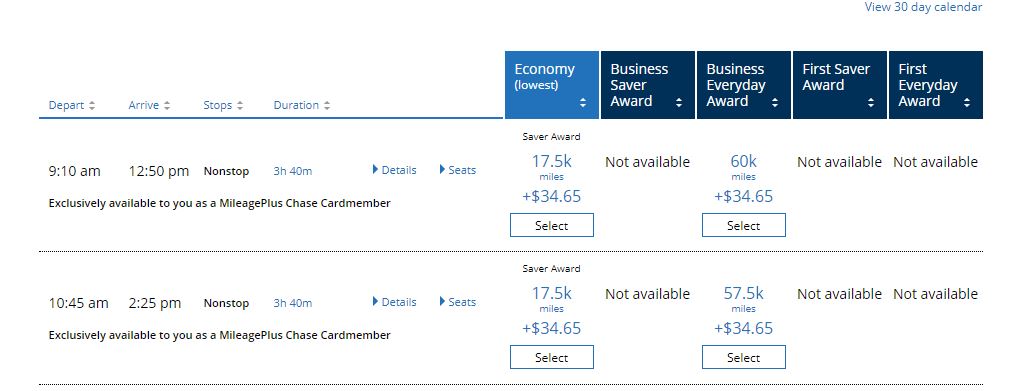
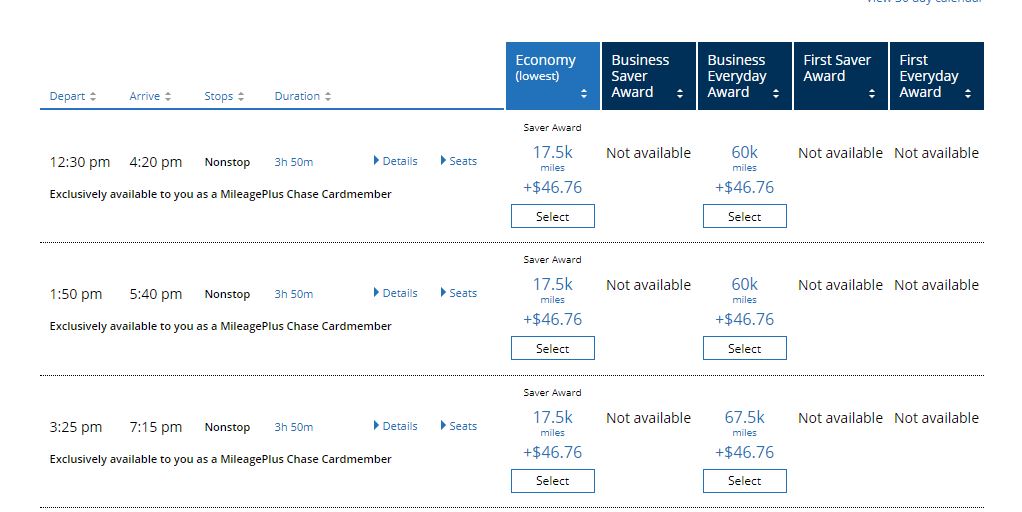
I used an example itinerary from Chicago (ORD) to Cancun from July 29th to August 4th. In both instances, we’re going to use award redemptions. The first example is the redemption available to Chase United MileagePlus credit card holders.
This is the segment from Chicago to Cancun. Two non-stop options, worth 17.5k miles, are available exclusively with the MileagePlus credit card.These are the options for the return. Three non-stop options if you hold the credit card. 35k miles for the roundtrip for one passenger.
Now let’s look at redemption availability if you want to book this same trip using United Miles, but don’t hold the United MileagePlus Explorer credit card:
If you want the non-stop option, it will cost 25k miles rather than the 17.5k miles seen above.
They have one 17.5k redemption to get to Cancun, but look at that disgusting itinerary. Not only are you departing at 6 a.m., but you have to switch airports in D.C. By the time you’re in Cancun, you’re spent.The return trip to Chicago would cost 25k miles. There is no 17.5k option available for the return.
As you can see in the example above, having the Chase MileagePlus Explorer card means you’re using only 35k miles (plus the applicable taxes) with the benefit of having a non-stop flight on both legs of the journey. Without it, you’re using, at a minimum, 42.5k miles, and likely 50k miles if you want to have a non-stop each way and a productive first day in Cancun. How much is that 15k miles savings worth? The Points Guy values each United mile at 1.5 cents. 1.5 x 15k = $225. This is just an estimate, but even if you value it a bit lower, it becomes obvious that the miles you saved by having the card are worth far more than the annual fee of $95 you’d be paying to keep the card. Again, this card isn’t for everyone; travelers who live near a United hub would benefit the most. If you are a Chase Sapphire Preferred/Chase Sapphire Reserve cardholder and find yourself transferring Ultimate Rewards points into United often, pairing the MileagePlus Explorer card with either of them only enhances their value.
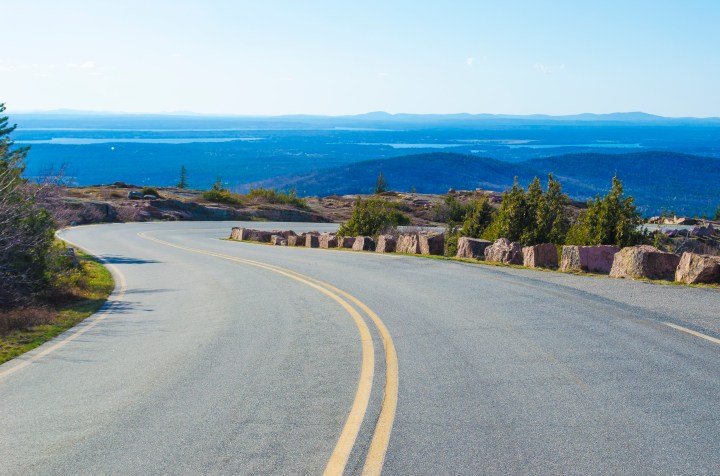
Acadia National Park had been on the bucket list for quite a while. Acadia National Park encompasses a large area of Mount Desert Island off the coast of Maine. This beautiful setting is known for its stunning vistas, scenic hikes, and ocean views from Cadillac Mountain. This is also the first place in the U.S. where you can see the sunrise between October and early March. If you’re visiting in the peak of summer, you can swim at Sand Beach when the water temperature is more tolerable. We drove from Albany, NY, and it took us about 7 hours to get there. Acadia National Park is about a 4.5-hour drive from Boston and an 8-hour drive from New York City. If you’re not close enough to drive, you can fly into Bangor International Airport, about 50 miles from Bar Harbor. We used Bar Harbor as our base camp and gateway into Acadia National Park.
On a recent trip to Portugal, my wife and I had the privilege of visiting the Polaris Lounge in Chicago. The lounge was unlike any other airline premium airport lounge we had ever visited in the United States. Before United launched Polaris Lounges in the U.S., American carriers did not have a product that could compete with the business-class lounges of Qatar Airlines, Etihad, Emirates, Cathay Pacific, Singapore Airlines, etc. United has expanded this product to San Francisco, Newark, Houston, Los Angeles, and Washington Dulles. Many travel experts and bloggers consider Polaris Lounges among the best airport lounges in the U.S.
Cape Cod is one of those timeless destinations with the charm of past decades. Most of the hotels on the Cape are independently owned mom-and-pop operations, and you won’t find many chain hotels. If you ask locals where to find the best lobster roll and seafood on the Cape, each person will likely give you a different answer as loyalties run deep. Whether you’re staying in Sandwich (the first town on the Cape), Provincetown (the last town on the Cape), or any other town in between, a beautiful beach and fantastic seafood are right around the corner.










 Miles for places